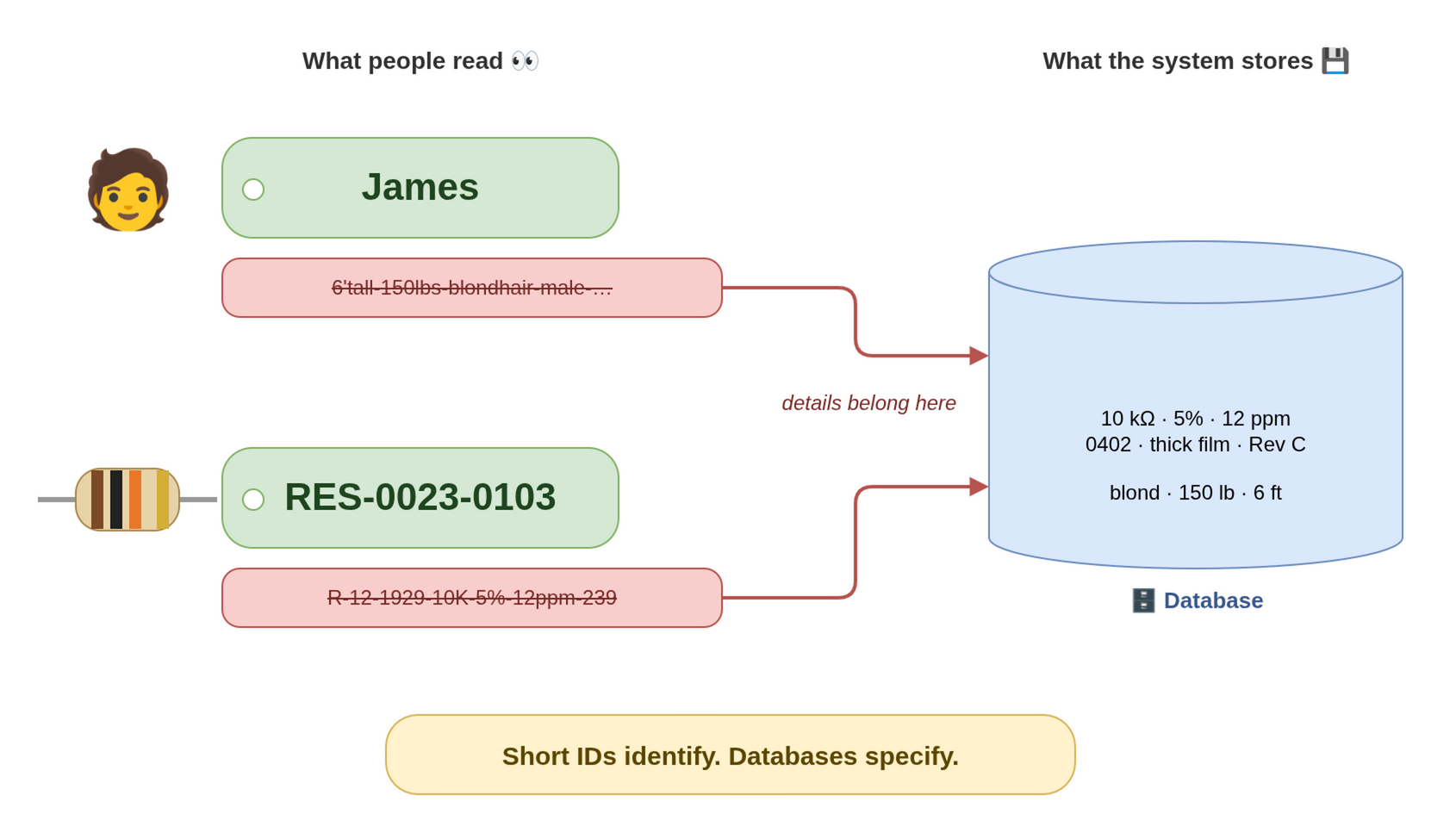
🏷️ IDs are not about details
With part numbers, serial numbers, and similar identifiers, the natural tendency is to over-specify. Why not encode the color, size, shape, and material in the part number? Why not encode the manufacturing date, the version, and the phase of the moon in the serial number? The information is useful.
IDs printed on devices serve humans, not machines. A QR code covers the machines, and that is a separate concern. The IDs discussed here are the ones people read while installing, locating, reporting, provisioning, and debugging devices in the lab, factory, and field.
A recent discussion turned to how much could be packed into a part number. Working through why that adds friction, I compared part numbers to people's names. Nobody refers to a person as:
6'tall-150lbs-blondhair-male-...
We call him James. Some attributes of a name do carry meaning: family names group relatives, and many first names signal gender. But the primary handle is the first name, and it is short, fast, and easy to say. Most people recognize well over a thousand of them.
Part numbers work the same way. A category and a common base for variations
help, and beyond that a sequential number covers the job. After a few weeks,
-0006 reads as 0402 resistors and -0232 as M4 screws. A couple dozen part
number bases fit in human memory without much effort. And when matching a part in a
bin against a BOM, this
RES-0023-0103
compares far more easily than
l10291029192291092
or
R-12-1929-10K-5%-12ppm-239
Identification is the concern here, not specification. Efficient identification keeps iteration loops tight and the work accurate. In drawings, BOMs, the lab, and the field, that difference shows up every day.
Leave the details in the databases. That is what they are for.