🔧 What has changed around edge build systems?
Reflecting on Embedded Linux/Edge build systems, several things have changed:
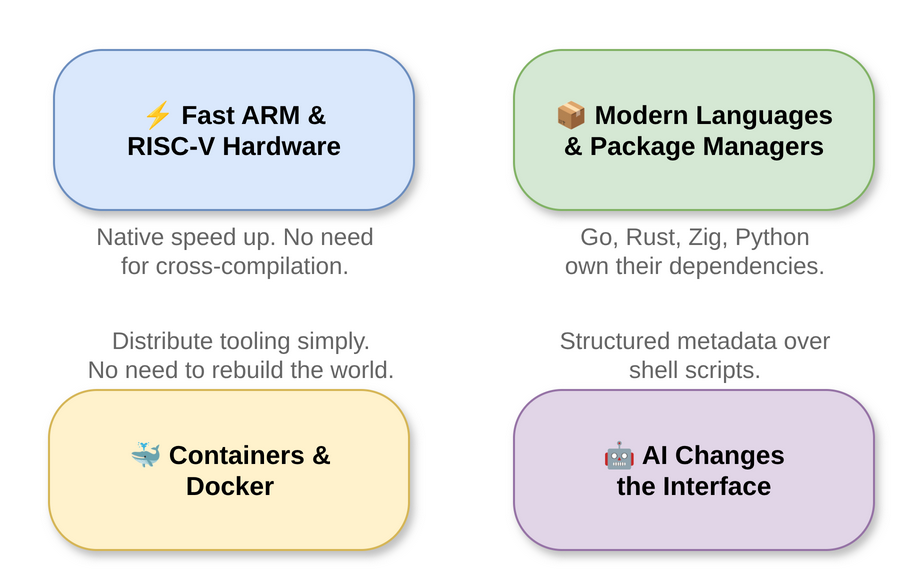
- ARM and RISC-V hardware is fast. Modern ARM boards and cloud instances (AWS Graviton, Hetzner CAX) build at speeds that make cross-compilation unnecessary for most workloads. For development, QEMU user-mode emulation can build ARM images on x86 without a cross-toolchain — slower, but correct and simple.
- Applications are moving to modern languages. Go, Rust, Zig, Python, and Node.js have their own dependency management, package managers, and caching. The elaborate cross-compilation and sysroot machinery in traditional build systems targets C/C++ and applies less to these modern languages. Build systems that work with these packaging systems, rather than trying to replace them, tend to gain more traction.
- Docker changed how teams distribute tooling. Containers offer a simple and efficient way to distribute build tooling, reducing the need to rebuild the world.
- AI changes the interface. Build systems are hard because there are thousands of tedious details to sort through, dozens of different build tools, and hundreds of different projects that all do things a little differently. AI turns out to be quite good at sorting through all this, but works best when build metadata is structured and queryable rather than buried in shell scripts and environment variables.
This is not the same world as 20, 10, or even 1 year ago. It may be time for a new edge build system … stay tuned 🙂.