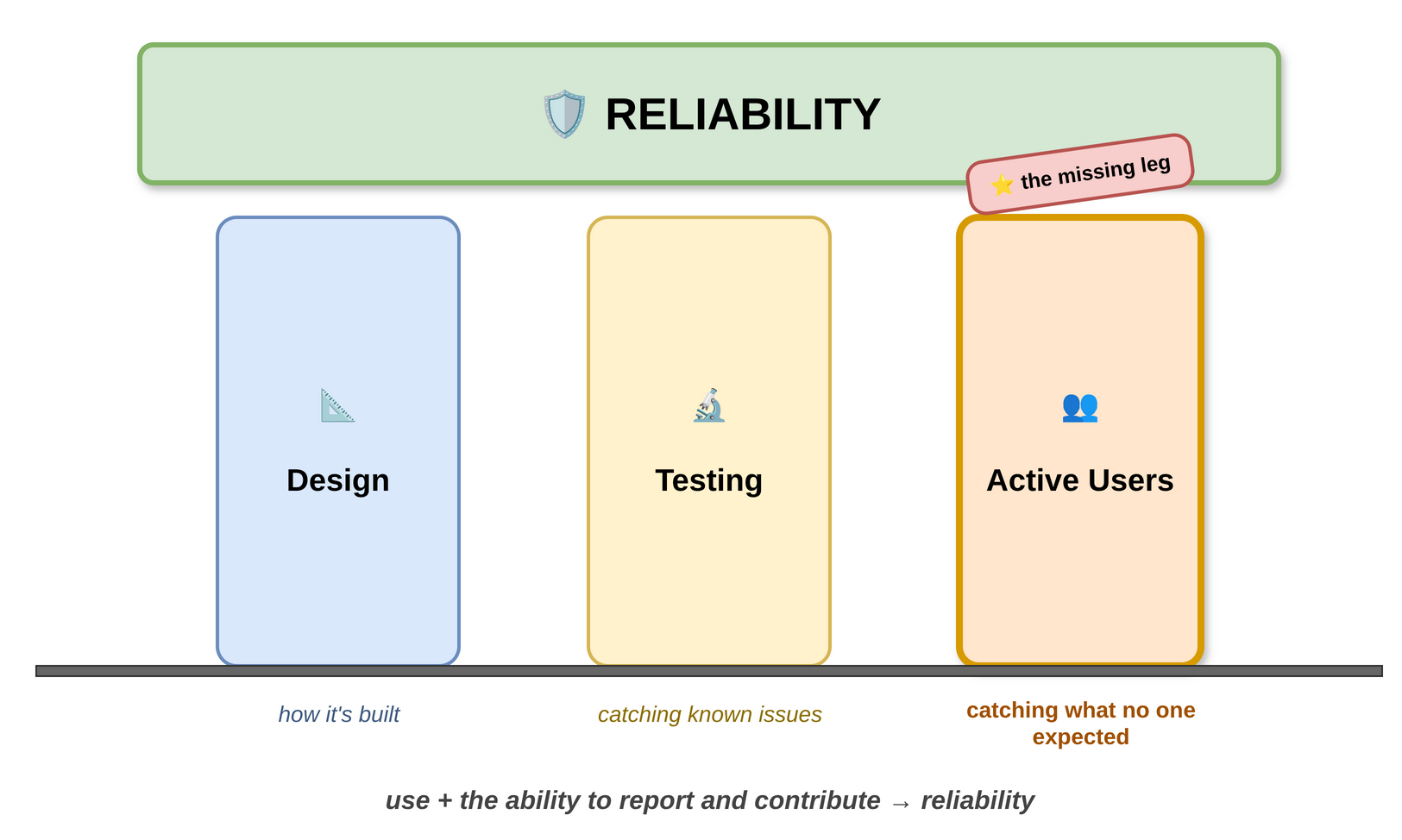
🪑 The missing leg of reliability
After a conversation with Tim Bird about Space-Grade Linux, an idea about reliability emerged. The obvious legs of reliable systems are design and testing. What is less obvious is the third leg: active users.
Use, coupled with the ability to report issues or contribute changes, directly correlates to reliability. Those of us running Arch Linux fearlessly upgrade our systems, and don't worry that things are going to break with a new kernel version. While Linux has strict design requirements and some testing, the biggest contributor to its reliability is its large, active user base. By active, I mean someone who can report problems or contribute fixes. Microsoft Windows has a large user base too, but users are insulated from developers and it shows.
Just this week, I was collaborating with a user on a reporting feature and uncovered a subtle bug in how daylight savings time was handled — the kind of thing my own testing was never going to catch. As systems get more complex, this kind of active use matters more, especially for small teams without chip-scale verification resources. Release First is the approach I'm trying with all my projects to eliminate the barrier between developers and users, and let use help drive reliability.