🛩️ Why did the Wright Brothers succeed?
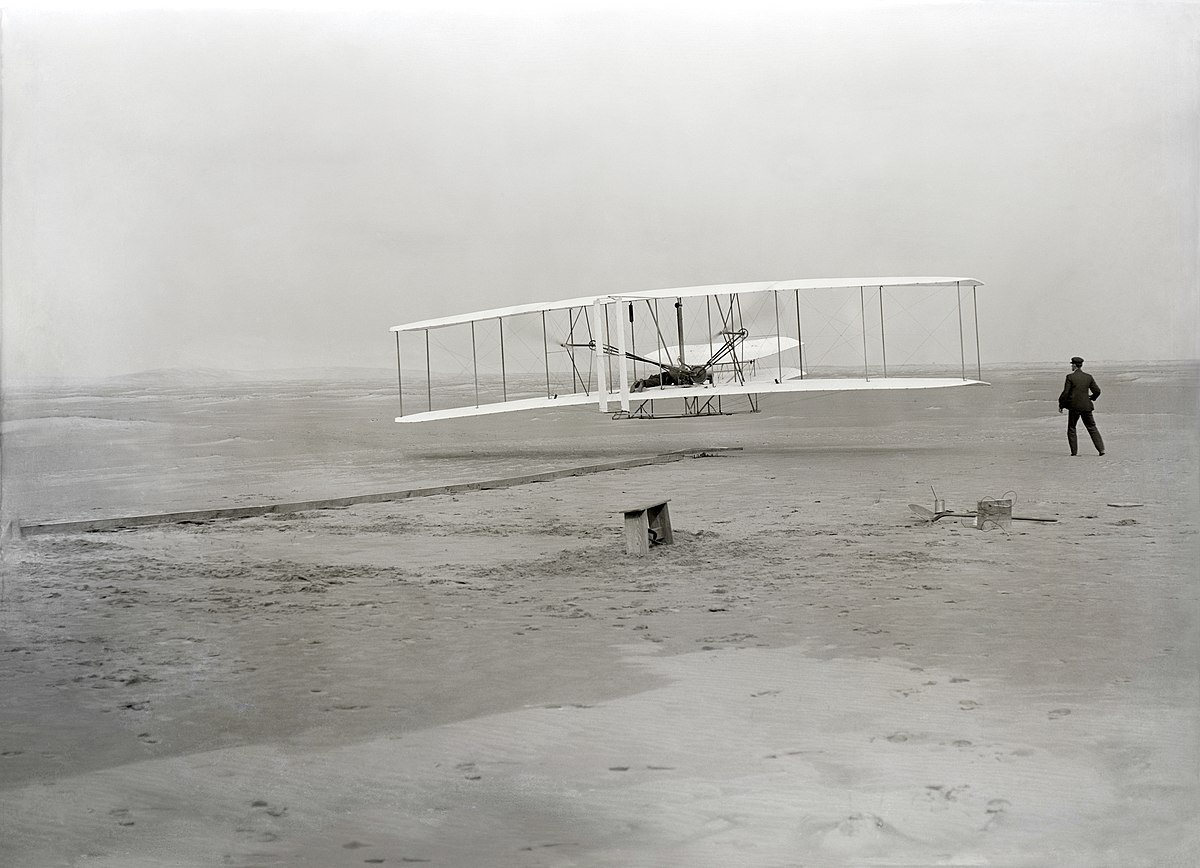
While Samuel Langley had $100,000 (equivalent to $3.5 million today) in funding, a team of engineers, and Washington connections, the Wrights were bicycle mechanics from Dayton, Ohio with a fraction of those resources. Langley's approach was to design the perfect flying machine on paper, build it, and then attempt a single dramatic launch. The Wrights took a fundamentally different path.
They did a lot of experiments. The Wrights built a wind tunnel and tested over 200 wing shapes. They flew over a thousand glider flights at Kitty Hawk before ever attaching an engine. Each flight was observable, measurable, and informative. They were not trying to fly; they were trying to learn.
They built the entire system, not just the exciting part. Langley focused on the engine and aerodynamics — the glamorous engineering. The Wrights recognized that control was the unsolved problem. They invented three-axis control (wing warping, rudder, and elevator) and practiced it through hundreds of glider flights. They built the ability to fly, land, adjust, and fly again — before optimizing the product.
They used short iteration cycles. Each season at Kitty Hawk was a learning cycle. They would fly, observe, return to Dayton, analyze, redesign, and come back. Problems surfaced early. When published lift tables turned out to be wrong, they discovered it through testing, built their own wind tunnel, and generated correct data. They didn't wait until the final launch to find out their assumptions were flawed.
Langley's failure was a Release Last failure. Langley tested his full-scale Aerodrome exactly twice. Both times it crashed into the Potomac. With no incremental learning, no progressive testing, and no feedback loop, two failed launches ended the entire program. The gap between design and reality was never closed because there was no mechanism to close it incrementally.
Why did the Wright brothers succeed with 100x less funding and far fewer resources than Langley? They took a Release First approach, with many small iterations. They developed prototypes that saw real use — a process that surfaced reality early and often. They released. They measured. They adjusted. And they flew. Langley went for the Big Release which resulted in a BIG 1.0 humiliation.
Resources don't always determine outcomes. The ability to release - to put something real into the world, learn from it, and iterate - does.
Cliff Brake April 02, 2026 #release #iteration #feedback #testing #process #engineering #strategy