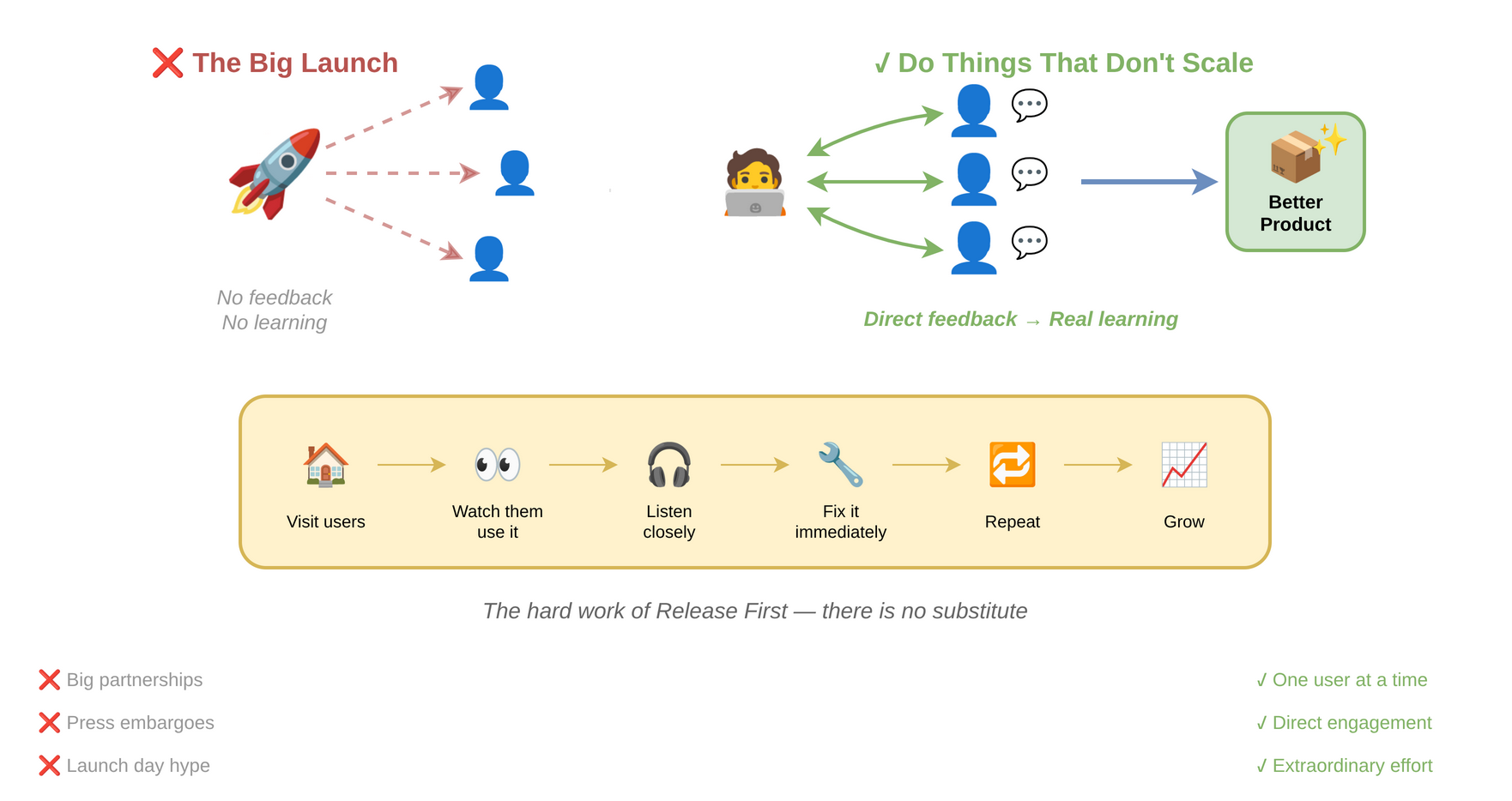
🛠️ Do things that don't scale
From Paul Graham's popular essay Do Things That Don't Scale:
Over-engaging with early users is not just a permissible technique for getting growth rolling. For most successful startups it's a necessary part of the feedback loop that makes the product good. Making a better mousetrap is not an atomic operation. Even if you start the way most successful startups have, by building something you yourself need, the first thing you build is never quite right. And except in domains with big penalties for making mistakes, it's often better not to aim for perfection initially. In software, especially, it usually works best to get something in front of users as soon as it has a quantum of utility, and then see what they do with it. Perfectionism is often an excuse for procrastination, and in any case your initial model of users is always inaccurate, even if you're one of them. 7
The feedback you get from engaging directly with your earliest users will be the best you ever get. When you're so big you have to resort to focus groups, you'll wish you could go over to your users' homes and offices and watch them use your stuff like you did when there were only a handful of them.
I should mention one sort of initial tactic that usually doesn't work: the Big Launch. I occasionally meet founders who seem to believe startups are projectiles rather than powered aircraft, and that they'll make it big if and only if they're launched with sufficient initial velocity. They want to launch simultaneously in 8 different publications, with embargoes. And on a Tuesday, of course, since they read somewhere that's the optimum day to launch something.
It's easy to see how little launches matter. Think of some successful startups. How many of their launches do you remember? All you need from a launch is some initial core of users. How well you're doing a few months later will depend more on how happy you made those users than how many there were of them. 10
So why do founders think launches matter? A combination of solipsism and laziness. They think what they're building is so great that everyone who hears about it will immediately sign up. Plus it would be so much less work if you could get users merely by broadcasting your existence, rather than recruiting them one at a time. But even if what you're building really is great, getting users will always be a gradual process — partly because great things are usually also novel, but mainly because users have other things to think about.
Partnerships too usually don't work. They don't work for startups in general, but they especially don't work as a way to get growth started. It's a common mistake among inexperienced founders to believe that a partnership with a big company will be their big break. Six months later they're all saying the same thing: that was way more work than we expected, and we ended up getting practically nothing out of it. 11
It's not enough just to do something extraordinary initially. You have to make an extraordinary effort initially. Any strategy that omits the effort — whether it's expecting a big launch to get you users, or a big partner — is ipso facto suspect.
What Paul is talking about here is Release First — the extremely tedious, manual effort required to get usable stuff in front of real users. There is no substitute.