🔄 Breaking the AI slop cycle
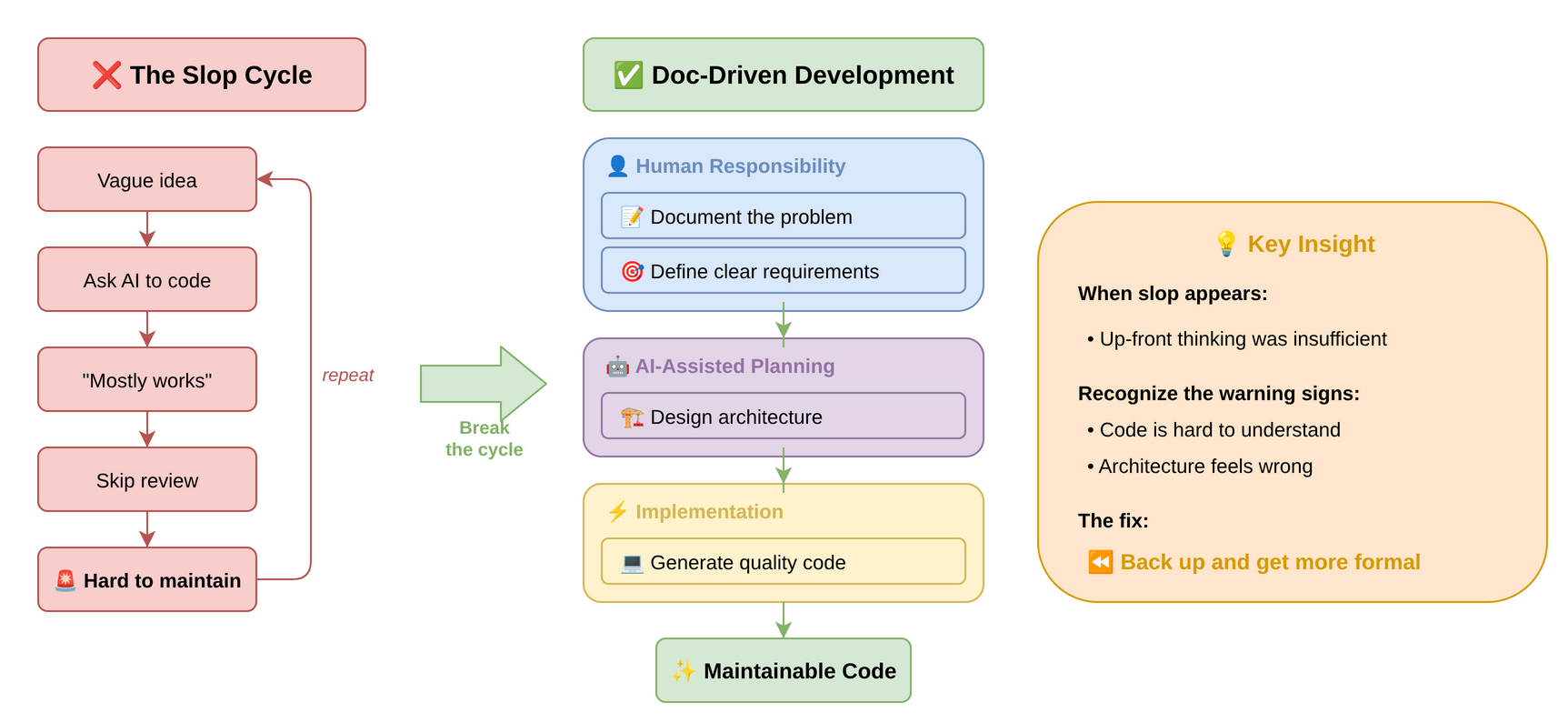
"AI Slop" is a common expression describing a familiar phenomenon. It refers to sloppy code (or other assets) generated by AI that mostly works, lacks proper review, and may be poorly architected or implemented. The primary characteristic of AI Slop is that it is hard to read, understand, and maintain.
Like anything else, fixing problems early in the cycle works best—not generating slop in the first place instead of trying to clean it up later. Even AI tools, as powerful as they are, have trouble cleaning up slop. Once the slop is cast in code, AI (like a human) is very reluctant to throw away all the hard work and start over.
So how does one break the cycle? The best method I've found is a lightweight formal documentation and planning workflow. The documentation ensures good thinking about what the problem is, what needs to be built, and why. The planning stage helps ensure the architecture is good. It is much easier to think about and rework a plan than code.
The documentation/planning steps also clearly delineate the responsibility of humans and AI. While AI can help explore options, it still does not have the entire context that humans have when it comes to clearly defining the problem.
When slop appears, this means the up-front thinking was not very good. One of the most useful skills when working with AI is recognizing when the slop zone is approaching, backing up, and getting more formal.
Cliff Brake December 15, 2025 #AI #coding #quality #documentation #planning #architecture #maintainability #process