🔄 The release circle
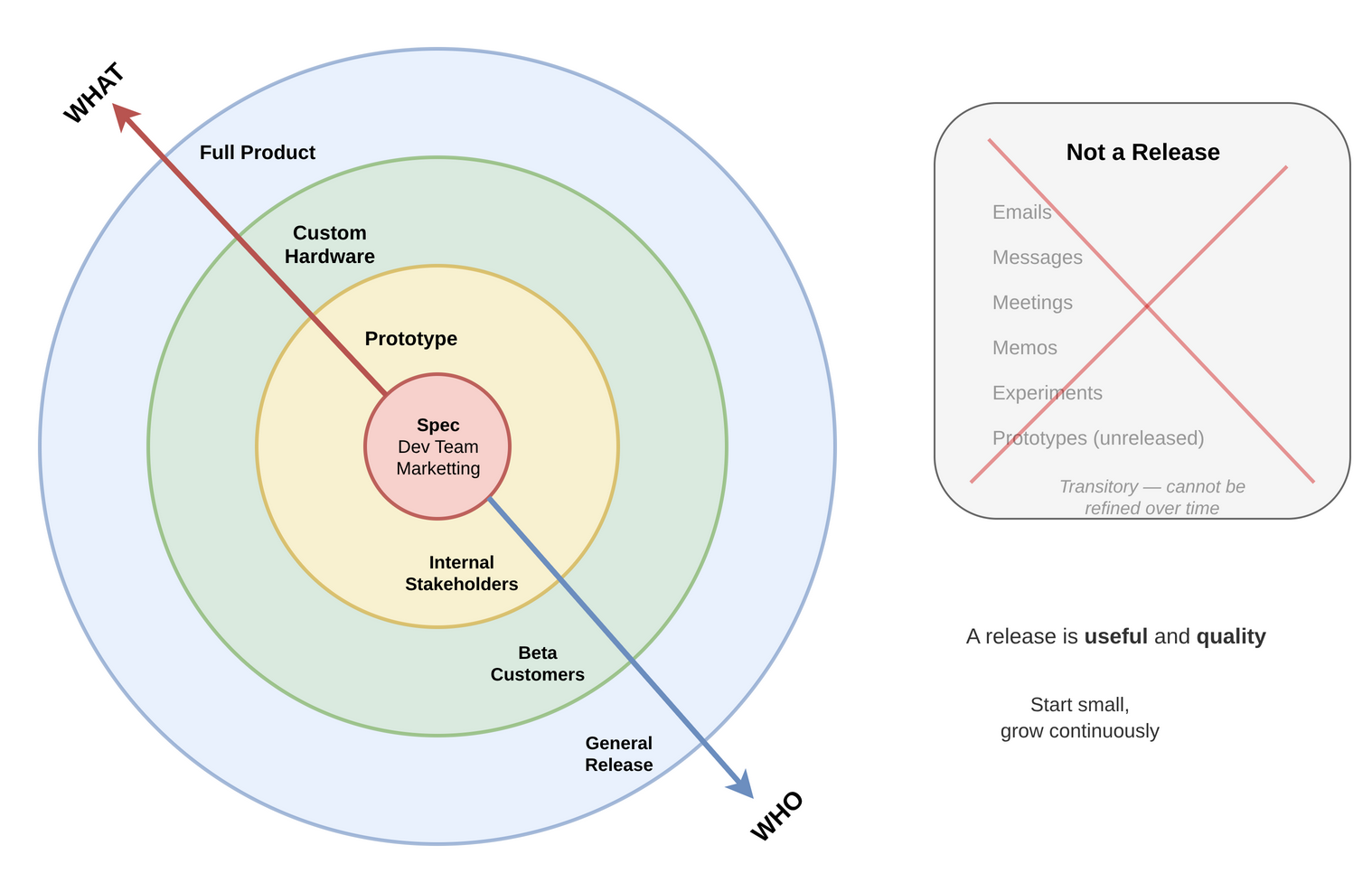
As previously discussed, a release is useful and quality. What counts as a release? One way to think about this is to view the release as a circle with two attributes:
- What (it contains)
- Who (it's for)
Initially, there is not much in the circle (perhaps only a specification), and only the development team and a few others in the organization are interested. But it is something that can be used and built upon. The team will change and expand it, but it will continue to exist in some form in all future releases. This might start with a spec, then a UI prototype in the cloud, then a device prototype based on a single-board-computer, then a custom system-on-module PCB, and so on. As time goes on, the functionality expands and improves.
The circle of who uses a release also expands over time, to include sales and marketing, management, beta-customers, and finally a general product release. Over time, the number of customers also grows to include more varied use cases.
The key point is to release a small slice of permanent functionality early, and then continue to grow/add slices and the number of people who use the product during the product development cycle. Waiting until the BIG Release is too late. It's OK to start small. As long as it's a release.
But there are things that are not a release:
- Emails
- Messages
- Meetings
- Memos
- Experiments
- Prototypes (that are not released)
Why? Because this information is not permanent. While others consume it and find it very useful, it is transitory and cannot be continually used, refined, and improved over time. It is one-off communication.